Table of Contents
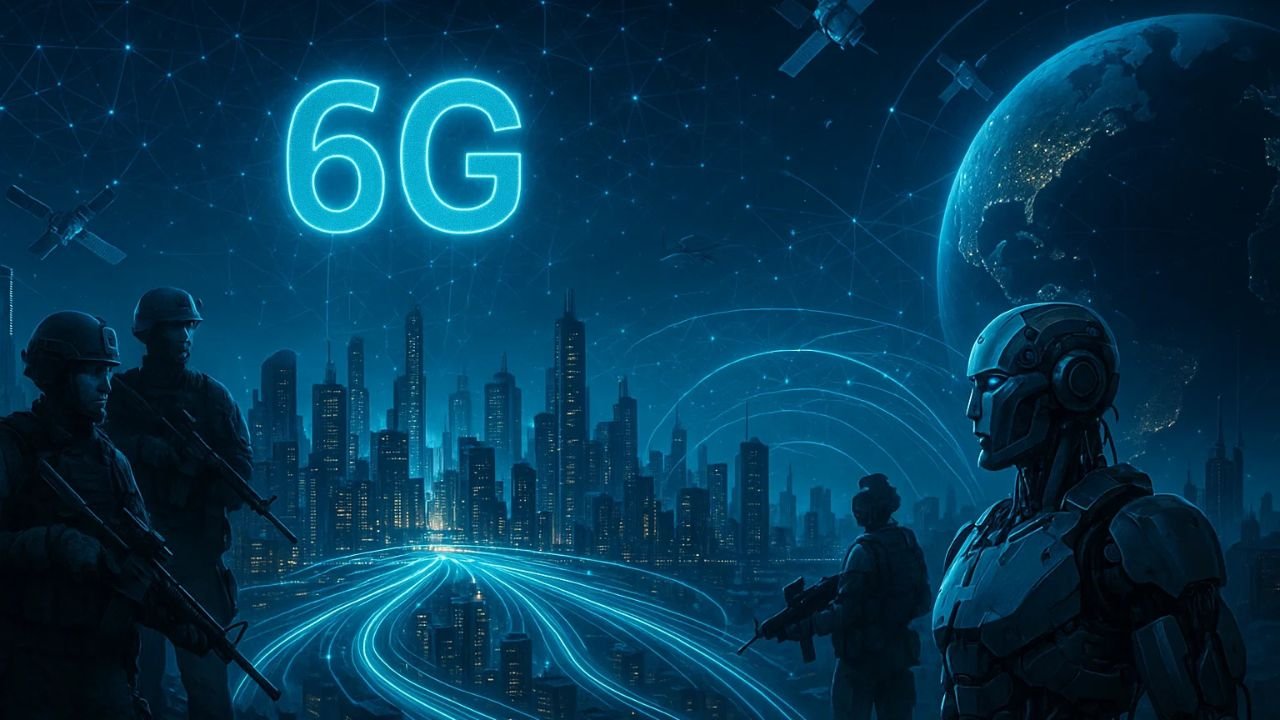
The race to 6G – the sixth generation of wireless networks is well underway. 6G promises terabit-per-second speeds, sub millisecond latency, and the ability to connect millions of devices per square kilometer. It will natively integrate artificial intelligence, sensing, and satellite networks (non-terrestrial systems) into the mobile infrastructureeetimes.com. In short, 6G is not just a faster 5G: it represents a transformative shift in technology. According to U.S. officials, shaping 6G standards now could determine future economic and military advantagesdefensenews.com. As one expert warns, whoever leads 6G will gain “not just a formidable economic edge, but also a decisive national security advantage”. This article explores what 6G is, who is leading in 6G development, and why control of 6G technology could tilt the global balance of power.
What is 6G and how is it different from 5G?
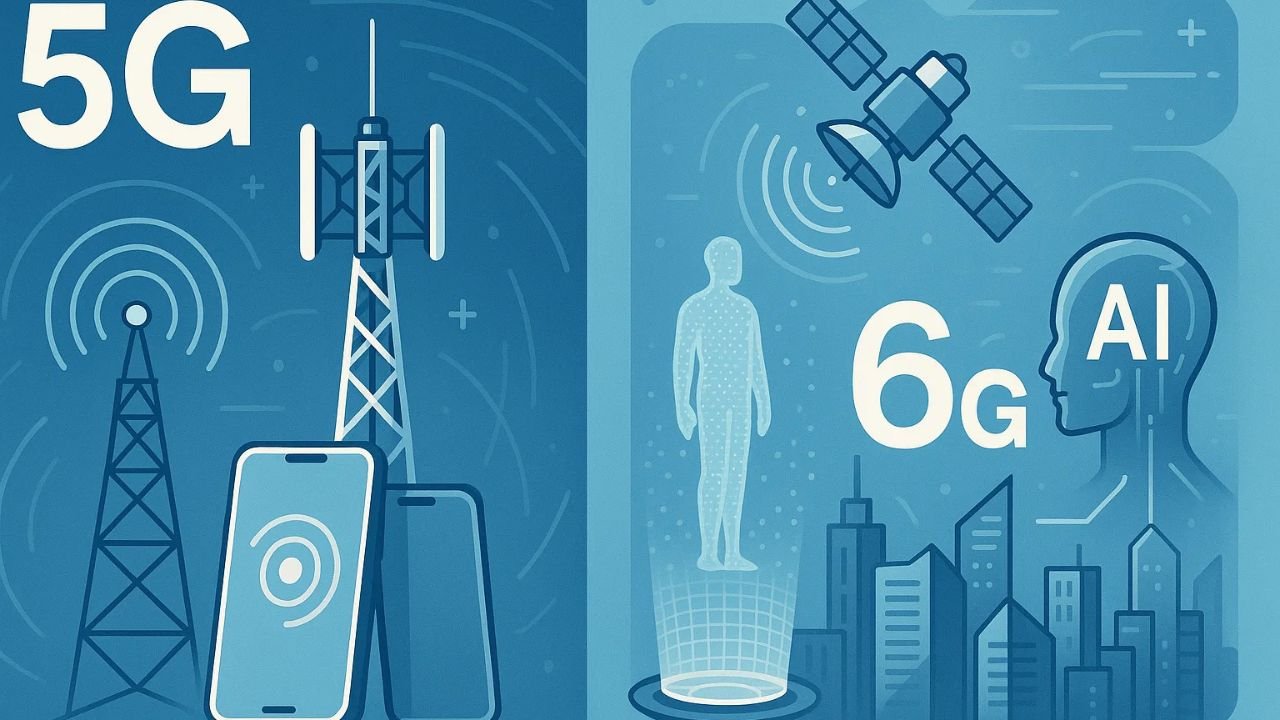
6G is the next evolution of mobile networks, currently targeted for commercial rollout in the early 2030s. Unlike previous generations, 6G is being designed from the ground up as a highly flexible platform for both communication and sensing. Performance targets under study include data rates up to 1 terabit per second, latencies as low as 100 microseconds, and support for 10 million devices per square kilometer. By comparison, 5G offers peak speeds on the order of gigabits per second and device densities measured in the hundreds of thousands.
Key innovations expected in 6G include:
- Terahertz-frequency bands for ultra wide bandwidth, far beyond 5G’s spectrum.
- Integrated sensing and communications (ISAC) so that networks can simultaneously carry data and sense the environment (e.g. for radar like imaging or IoT sensing)eetimes.com.
- Artificial intelligence built into the network, enabling real-time optimization, predictive maintenance, and new applications like fully immersive virtual or holographic communications.
- Tightly coupled satellite or aerial networks (non-terrestrial networks) as part of the cell structure, extending coverage globally.
These changes mean 6G is envisioned as a platform for pervasive intelligence, connecting humans, machines, and even “digital twins” of real world systems. For example, 6G could enable holographic telepresence, truly autonomous vehicles communicating in real time, and vast networks of industrial robots and sensors. One analyst notes that 6G could be “the most transformative communications revolution since the advent of the internet”ainvest.com.
Despite its promise, 6G also raises new challenges: the need to master terahertz electronics, manage enormous energy demands, and develop global standards for these novel capabilities. In short, 6G is much more than just faster 5G. It is a paradigm shift in how networks are built and used.
Early Leaders in the 6G Race
No country or company has an operational 6G network yet, but a global race is on. China has been particularly aggressive. The Chinese Ministry of Industry and Information Technology (MIIT) set up the “IMT‑2030” (6G) Promotion Group and announced that formal technical standard research would begin by mid-2025. China aims to finalize core 6G concepts by 2025, publish initial specifications by 2029, and begin commercial deployments around 2030. In fact, China launched the world’s first experimental 6G satellite in late 2020 to test terahertz signalseetimes.com. Leading Chinese firms such as Huawei and ZTE are making massive investments in 6G. Huawei, which started its 6G research back in 2017, now describes the technology as a “distributed neural network” that merges the physical and digital worlds.. Chinese leaders view 6G as a national strategic priority. A recent analysis calls China’s 6G roadmap a “geopolitical and economic masterstroke,” aiming to make China a leader in setting global standardsainvest.com.
The United States and its partners are also taking action. In 2024–2025, the U.S. government launched initiatives to encourage 6G research and spectrum allocationntia.gov. The Commerce Department’s NTIA solicited industry input on 6G and coordinated a joint statement (with countries like Japan, South Korea, France, UK, etc.) emphasizing a 6G that is “secure, open, and resilient by design”. U.S. telecom firms and university researchers are exploring terahertz communications and AI native networks; the FCC has already approved “experimental” licenses on some terahertz bands. The U.S. Defense Department’s Future Generation Wireless office is prepping the military for 6G. Pentagon leaders stress that shaping 6G standards early will give the U.S. influence over the future infrastructure. In contrast to China, U.S. officials emphasize open, interoperable, vendor-neutral architectures to avoid dependence on any one supplier.
Other players are notable. South Korea, after spearheading 5G deployment, has poured hundreds of millions into 6G R&D. Korean research so far targets a pilot 6G system by 2026 and commercial services by 2028. Samsung and LG are already doing 6G tests, and Korea’s spectrum authorities are nominating candidate bands at global telecom meetings. Japan has launched the “Beyond 5G Promotion Consortium,” bringing together the government, major companies like NTT DoCoMo and Toshiba, and academic institutions to accelerate progress toward 6G. Japan has earmarked roughly $9.6 billion for future tech (including 6G) and aims to roll out its own 6G systems by 2030. Europe is organizing too: the EU’s Hexa-X flagship research program involves Nokia, Ericsson and others to develop 6G building blocks, with dozens of millions in public funding. The EU’s 6G Infrastructure Association (6G-IA) aims to finalize standards around 2028ainvest.com.
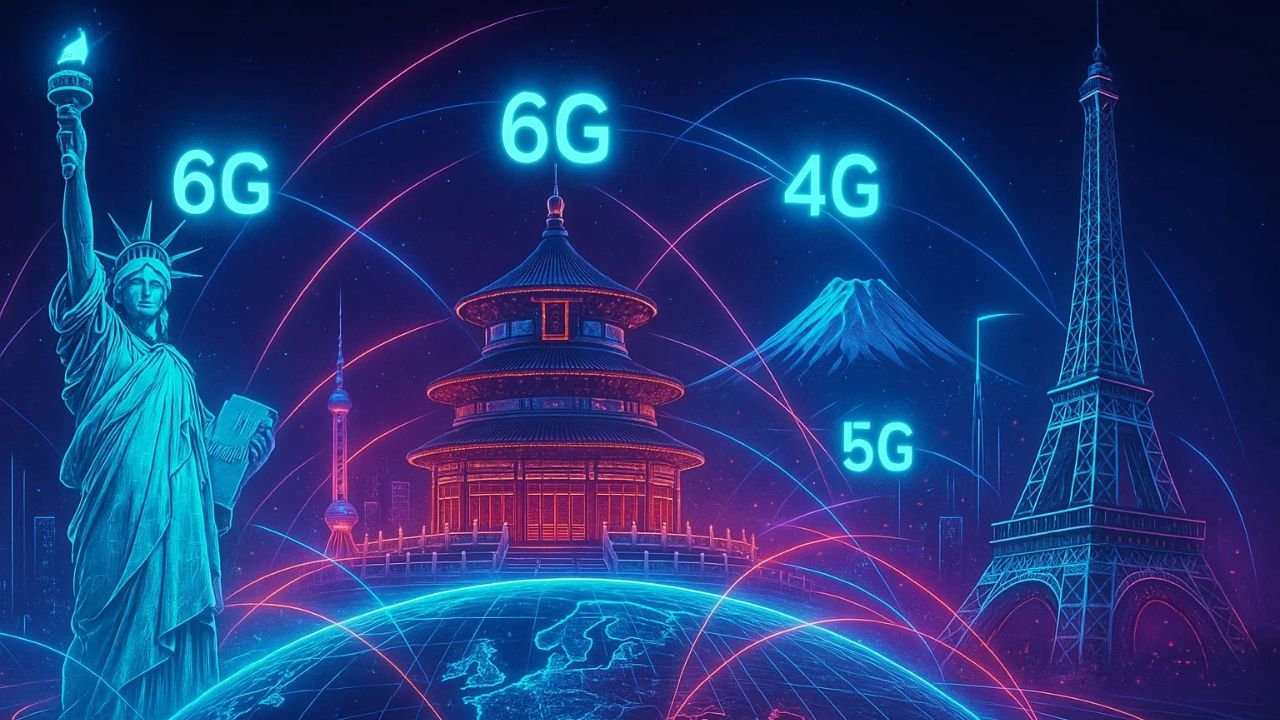
In short, every leading economy China, the U.S., South Korea, Japan, and Europe is racing to define 6G technology first. They see 6G not just as a technical upgrade but as a key to future competitiveness. Governments are forging international partnerships (for example a U.S.-led “Next G Alliance” groups North American companies), while Chinese groups also sign memoranda with European research bodies to cooperate on 6G. The global 6G market is forecast to be worth hundreds of billions within two decades, so being at the front of the pack means access to huge economic opportunity.
Economic and Military Stakes of 6G
6G’s impact will go far beyond mobile phones. Economists and security experts warn that the first country to master 6G could reap trillions of dollars and gain a strategic edge. By 2030, 5G networks are expected to generate close to $11 trillion in economic value worldwide. Analysts believe 6G could easily exceed those figures, enabling new industries built on ultra-fast, always-on connectivity.
On the economic front, 6G will underpin innovations like smart cities, widespread automation, advanced telemedicine, and the internet of things on a massive scale. It could enable consumer experiences (like mobile holograms or full-immersion VR) that 5G can’t support in full. As one industry leader notes, if the U.S. misses out on 6G it would “repeat the same mistakes [made] with 5G,” losing out on innovation and market share. Companies in chipmaking, telecom equipment, and software stand to gain if their home country leads. For example, Chinese firms Huawei and ZTE currently hold around 40% of global 5G patents and are expected to be 6G R&D leadersainvest.com. Western firms like Nokia, Ericsson, and Samsung also eye 6G as a chance to dominate next-generation networks. Governments are therefore pouring money into R&D: the U.S. encouraged new spectrum auctions and research programs, Europe funded multi million euro projects, and Asia allocated public funds to telecom consortia.
Militaries also see 6G as crucial. The Pentagon’s 6G efforts highlight applications like autonomous drones, robotics, real time logistics, and advanced sensing. FutureG Office director Thomas Rondeau explains that 6G could “pave the way for more dependable high speed, low latency communication” supporting military interests from VR training to integrated sensing and communications (ISAC) systems. For example, 6G signals could be used to detect and track hostile drones or provide instant battlefield connectivity. However, this dual use nature cuts both ways: the same technologies could help adversaries. Pentagon leaders note that things like space based sensors or AI driven networks “if commercialized, could make [them] accessible to adversary nations” who might “weaponize” them. Therefore, control of 6G architecture is seen as a national security priority. The U.S. effort to ensure “open source” and secure 6G architectures stems from lessons learned when Chinese 5G gear (from Huawei) dominated global networks and caused security concerns.
In short, 6G is set to become the foundation of both future economies and military power. Mastering it means large-scale industrial growth and influence over the technologies of tomorrow which is why strategic thinkers call 6G leadership a matter of both economic dominance and military advantagedefensenews.com.
The Battle Over Standards and Infrastructure
A key arena of 6G competition will be standards and infrastructure control. The world relies on common technical standards (set by bodies like the ITU and 3GPP) so that equipment from different vendors works together and networks interconnect across borders. Whoever shapes those standards can embed their own designs into the global system.
China’s strategy is explicit: Beijing aims to become a standard setter, not just a producer. For instance, China’s “IMT-2030 Promotion Group” is leading national 6G efforts while also taking part in global forums such as 3GPP. China’s Vice Minister even signed an agreement with Europe’s 6G-IA to “promote cooperation on 6G systems”. At home, regulators have allocated the mid-band spectrum (6 GHz band) specifically for future 6G use to keep Chinese industry aheadeetimes.com. Chinese tech plans like “China Standards 2035” make it clear they intend to define the rules of next gen networks. And Chinese telecom giants like Huawei are building huge patent portfolios in 6G technologies.
Meanwhile, Western nations are pushing their own vision. The U.S. and allies stress open, multi-vendor, secure networks. The NTIA blog emphasizes that U.S. policy will support “open, interoperable, secure, and reliable” 6G approaches. The Pentagon’s FutureG office is specifically championing open source radio architectures to prevent any single company from controlling the network stack. Western companies such as Ericsson and Nokia are actively involved in 6G research and standardization through projects like Hexa-X, aiming to shape the core specifications of the technology. The 3GPP roadmap has already integrated 6G, with preliminary studies starting in Release 19 (2019) and the first official technical standards expected in Release 21 by the end of 2028.
In practice, we may see geopolitical friction. The U.S. has used export controls on advanced chips and sensors to slow China’s progressainvest.com. Likewise, Western countries have banned or restricted Chinese equipment in 5G; similar debates over trust and dependence will arise with 6G hardware. Many emerging economies will have to choose 6G suppliers, potentially repeating the “5G choice” fiasco. As one commentary puts it, network control is closely tied to sovereignty in the information age. If the U.S. and its allies fail to lead next-generation infrastructure, they risk being “beholden to foreign interests for critical communications technology.”heritage.org
Dependence and Risk: Why It Matters
The strategic worry about 6G is that dependency on a potential rival’s technology can translate into geopolitical leverage. We saw this in the 5G era when Chinese firms got entrenched in many networks worldwide. For 6G, the stakes are higher. One analysis bluntly warns that China’s next move will likely involve subsidized deals to lock in customers “straight from its 5G playbook”. Developing nations in particular may eagerly adopt cheap 6G kit, giving whoever supplies it outsized influence over those countries’ digital future.
For the U.S. and other democracies, over-reliance on “untrusted” networks could pose espionage and cyber risks. The Heritage Foundation commentary argues that failing to lead 6G would be catastrophic, making America “beholden to foreign interests” for essential infrastructure. The same author suggests partnering with allied vendors (Nokia, Ericsson, Samsung) to avoid dependency on any one power. In practice, this means governments are now pushing their industries to collaborate with like-minded countries and to diversify supply chains.
There are also broader economic security concerns. High tech industries like semiconductor manufacturing are critical for 6G. NTIA notes that U.S. China’s 6G efforts could be slowed by export bans on chips and artificial intelligence toolsainvest.com, but cutting off cooperation also risks fragmentation. At the same time, China’s control of a large share of 5G patents and manufacturing capacity (nearly 35% of global output) means the U.S. and others face big gaps if they decouple too abruptly. The push for 6G thus comes amid these supply-chain and trade tensions.
Ultimately, the “tech dependence” risk is that if a rival nation sets the standard or dominates the supply chain, it could potentially impose its regulations or exploit vulnerabilities. Critical infrastructure from power grids to defense systems will run on next gen networks. If adversaries own that foundation, they might disrupt services or gather intelligence at will. As one security expert bluntly concludes, “networks form the nerve centers of modern societies.” Whoever controls those networks holds considerable power over other nations.
Conclusion
The advent of 6G promises to usher in a new era of connectivity, but it also heralds a contest for technological supremacy. With its unprecedented speeds, AI driven intelligence, and global reach, 6G could redefine industries, economies, and militaries. Countries are acutely aware that early leadership in 6G can translate into lasting influence. China’s rapid government led push, the U.S. and allies’ open standards strategy, and the major investments by South Korea, Japan, and Europe all reflect a recognition: 6G is a strategic asset.
For policy makers and industry leaders, the message is clear: invest now, cooperate wisely, and shape 6G on terms that safeguard both economic opportunity and national security. As one analyst puts it, the technology future and with it, the balance of power depends on how this sixthgeneration network is built and governed. The world is watching, and those who determine 6G’s architecture and rules may very well reshape the global power balance for decades to come.
Sources: Authoritative technology reports and news analyses (cited inline) from government agencies, industry news sites, and research institutions inform this articledefensenews.com, among others. All facts and quotes are drawn from these up-to-date sources on 6G and geopolitical strategy.
Explore More with Global Mirror Official
Looking for more insightful reads? At Global Mirror Official, we bring you in depth articles on the latest innovations shaping our world. Don’t miss out on trending topics like:
- AI Tools for Crisis Reporting Explained
- AI for Ticket Management in IoT Systems
- IoT Artificial Intelligence: Is This The Future?
- GPT-5: The Future of AI Has Arrived
- Drones Through Time
Stay informed, stay ahead — only with Global Mirror Official.
