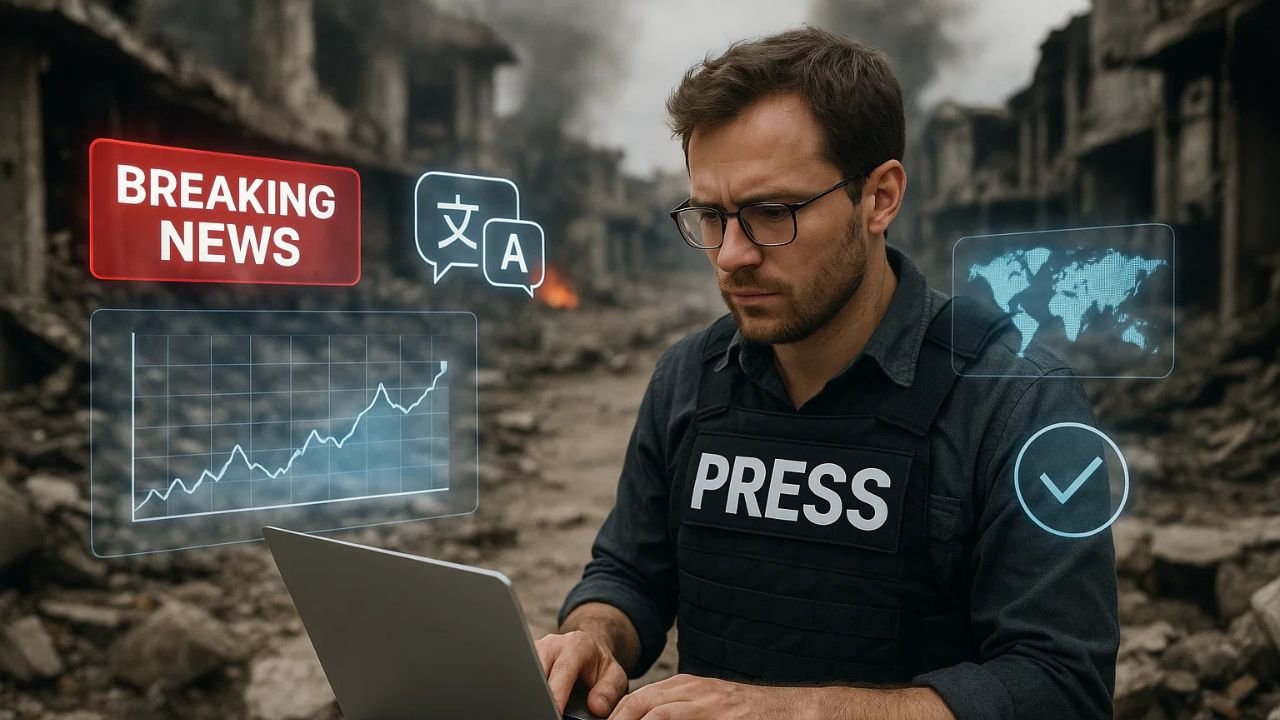
In today’s world, crises unfold faster than ever. Whether it’s a natural disaster, armed conflict, or political upheaval, information spreads instantly. but not always accurately. In such situations, AI tools for crisis reporting have become powerful allies for both professional journalists and everyday citizens. These tools help collect, verify, and present facts in a way that was nearly impossible a decade ago.
This article explores how AI tools like ChatGPT, image analyzers, translation systems, and visualization platforms are transforming crisis reporting. More importantly, it explains how anyone. whether a trained reporter or an ordinary citizen can use them responsibly to document events and share the truth.
Table of Contents
Why Crisis Reporting Needs AI
Traditional reporting relies heavily on human observation, access to sources, and manual verification. But during a crisis, these elements are limited:
- Journalists may not reach dangerous zones.
- Citizens may lack technical skills to document events clearly.
- False information spreads quickly, especially on social media.
This is where AI steps in. Instead of replacing human judgment, AI enhances reporting by:
- Speeding up information gathering
- Verifying visual and textual evidence
- Breaking language barriers
- Presenting data through clear visuals
The combination of human experience and AI assistance results in faster, more accurate, and more impactful reporting.
Key AI Tools for Crisis Reporting
1. ChatGPT and Other AI Writing Assistants
- Use Case: Journalists can draft articles, reports, or eyewitness summaries faster. Citizens can record their experiences in a structured way.
- How It Helps:
- Turns rough notes into clear narratives.
- Suggests headlines that attract attention without sensationalizing.
- Helps cross-check facts by suggesting sources or historical parallels.
Example: A citizen trapped in a flood zone can describe what they see, and AI can turn it into a short, publishable update for global audiences.
2. AI-Powered Translation Tools
- Use Case: Crises often happen in regions where global media struggles with language barriers. Tools like DeepL, Google Translate, or AI-integrated newsrooms allow content to be shared instantly across languages.
- How It Helps:
- Makes local voices accessible to global audiences.
- Prevents mistranslation that might distort the message.
Example: A Syrian resident posts an update in Arabic; AI instantly translates it for U.S. or European journalists.
3. Image and Video Verification (AI Tools for Crisis Reporting)
- Use Case: Disinformation campaigns often spread fake or altered images. AI tools like InVID or Microsoft’s Video Authenticator analyze metadata and detect deepfakes.
- How It Helps:
- Identifies whether footage is genuine or manipulated.
- Protects citizens from unintentionally sharing false material.
Example: During a protest, fake photos may circulate online. AI verification tools help journalists confirm authenticity before reporting.
4. Visualization and Mapping Tools (AI Tools for Crisis Reporting)
- Use Case: Crises usually involve complex data refugee movement, damage zones, or casualties. AI visualization platforms (Tableau with AI, Flourish, or even Google Earth AI features) make raw data understandable.
- How It Helps:
- Turns statistics into maps, timelines, and charts.
- Makes stories more engaging and credible.
Example: A journalist documents earthquake damage and uses AI to create a heatmap of affected areas, making the report clearer for international aid groups.
5. AI Voice and Audio Analysis Tools
- Use Case: In crisis zones, voice recordings may be safer than writing or filming. AI transcription tools like Otter.ai or Whisper (by OpenAI) convert audio to text.
- How It Helps:
- Speeds up note-taking for journalists.
- Allows citizens to document events without exposing themselves while filming.
How Citizens Can Use AI for Crisis Reporting
You don’t need to be a professional journalist to use AI effectively. Ordinary people can document events responsibly by:
- Recording raw data (photos, videos, or notes).
- Using AI writing assistants to make updates clear and neutral.
- Translating updates so international audiences can understand.
- Verifying materials before sharing to avoid spreading false content.
- Visualizing information like timelines of events or safe evacuation routes.
AI democratizes reporting. it gives power back to ordinary people who might otherwise go unheard.
Ethical Considerations AI Tools for Crisis
While AI tools for crisis reporting are powerful, they must be used carefully:
- Accuracy First: Always cross-check AI-generated content. AI can hallucinate facts.
- Safety of Sources: Do not expose identities that might put people in danger.
- No Sensationalism: AI can make writing catchy, but accuracy and respect should come before clicks.
- Bias Awareness: AI systems are trained on existing data, which can include biases. Journalists and citizens must apply judgment.
Benefits of AI in Crisis Documentation
- Faster Information Flow: Breaking news reaches the world almost instantly.
- Greater Accuracy: AI helps verify before publishing.
- Global Accessibility: Language barriers are reduced.
- Inclusive Reporting: Citizens become reliable contributors alongside professionals.
Challenges Ahead
Despite its promise, AI is not a silver bullet:
- Misinformation Risks: Bad actors can also use AI to spread deepfakes.
- Over-reliance: Human judgment is irreplaceable.
- Access Gaps: Not everyone in crisis zones has internet or device access.
These challenges highlight the importance of combining AI technology with human responsibility.
Conclusion
Crisis reporting has always been about truth, courage, and urgency. In the 21st century, AI amplifies these values by equipping journalists and citizens with tools that make documentation faster, clearer, and more reliable. From ChatGPT for drafting updates to visualization tools for mapping disasters, the role of AI is no longer optional. it is essential.
But the core principle remains: technology is only as powerful as the humans behind it. Journalists and citizens must use AI tools for crisis reporting with responsibility, empathy, and commitment to truth.
Final Thoughts
Crisis reporting is evolving fast and AI tools are at the heart of this transformation. Whether you’re on the ground or miles away, tools like ChatGPT, image verifiers, translation engines, and visual mapping software give everyone the chance to participate in truthful, impactful storytelling.
For more on related trends, consider reading:
- IoT Artificial Intelligence: Is This the Future? Explore how AI and IoT are partnering to create smarter, data-driven environments. globalmirrorofficial.com
- AI for Ticket Management in IoT Systems . Learn how AI helps automate issue detection and resolution in complex networks. globalmirrorofficial.com
Best Crisis Communication Software, Tools, And Platforms
