Table of Contents
Introduction
In today’s world, we often assume that every country officially recognizes every other country. However, international politics is far more complex. Surprisingly, many countries don’t recognize each other, even if those nations have their own governments, flags, borders, and people.
So why does this happen? Why do some countries refuse to acknowledge others as legitimate states?
This article explains why countries don’t recognize each other, using simple language, real-world examples, and a neutral, educational tone.
What Does “Country Recognition” Mean?
Country recognition is when one state officially accepts another entity as a sovereign and independent country. Recognition allows:
- Diplomatic relations
- Trade agreements
- International travel
- Membership in global organizations
Recognition is political, not automatic. A country can exist in reality but still lack recognition from other countries don’t recognize each other scenarios.
Types of Recognition
1. De Facto Recognition
Acknowledges control over territory but avoids full diplomatic approval.
2. De Jure Recognition
Full legal and diplomatic recognition as a sovereign state.
Many disputes happen because countries offer de facto recognition but refuse de jure recognition, leading to situations where Countries Don’t Recognize Each Other.
Main Reasons Why Countries Don’t Recognize Each Other
1. Political Pressure and Alliances
Countries often follow the stance of their allies. If a powerful ally opposes recognition, smaller countries may comply. Recognition can damage strategic relationships.
Example: Many nations do not recognize Taiwan because of pressure from China.
2. Territorial Disputes
If a country believes a territory belongs to it, it may refuse recognition. Recognizing the territory would weaken its own claim.
Example: The Israel–Palestine dispute remains one of the most complex recognition issues in the world.
3. Fear of Encouraging Separatism
Some countries worry that recognition could inspire separatist movements within their own borders. Governments prefer stability over risky precedents.
Example: Spain does not recognize Kosovo due to concerns over Catalonia.
4. Lack of International Consensus
Some countries wait for approval from global institutions like the United Nations. Without wide support, countries hesitate to act independently, causing countries don’t recognize each other scenarios.
5. Military Occupation or Conflict
If a territory is created through war or occupation, recognition becomes controversial. Countries may view the new state as illegitimate. Human rights concerns also play a role.
6. Ideological Differences
Political systems matter. Democracies may hesitate to recognize authoritarian regimes. Ideological conflicts can delay recognition. During the Cold War, recognition was heavily influenced by ideology.
7. Legal Questions Under International Law
Under international law, a country should have:
- Defined territory
- Permanent population
- Effective government
- Capacity to engage in relations
If any of these are disputed, recognition becomes difficult, leading to countries don’t recognize each other cases.
Famous Examples of Non-Recognition
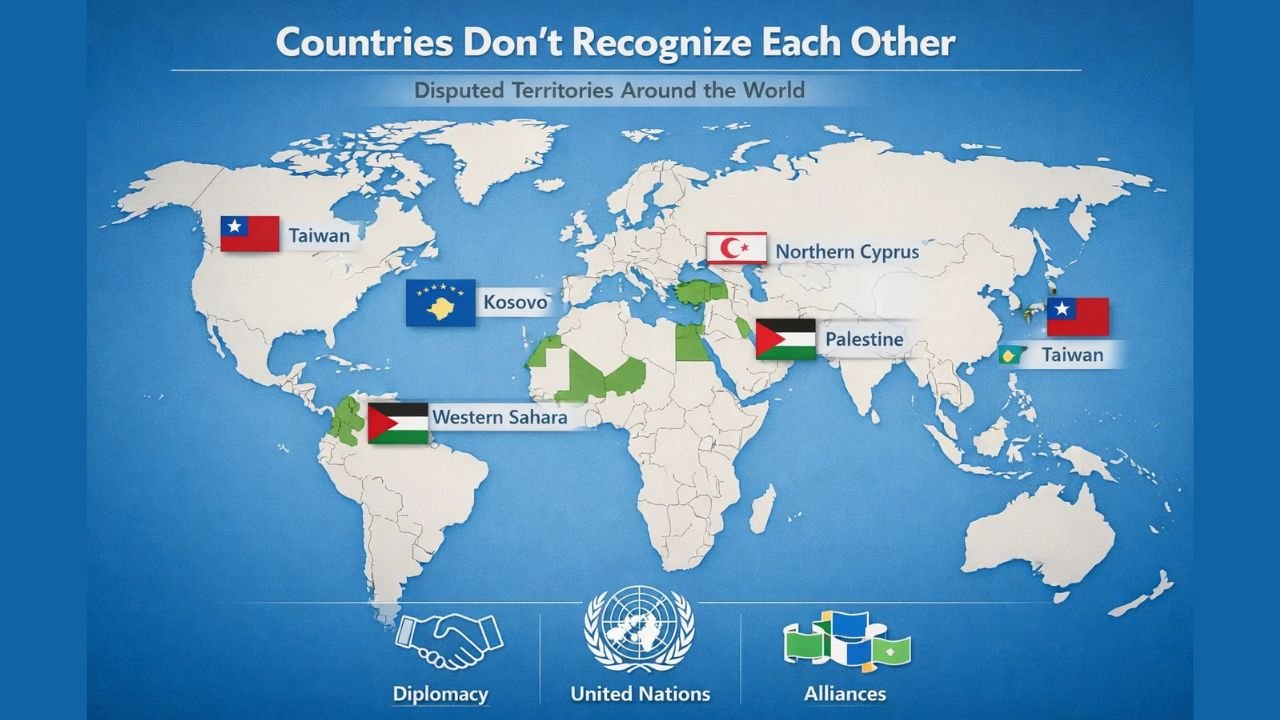
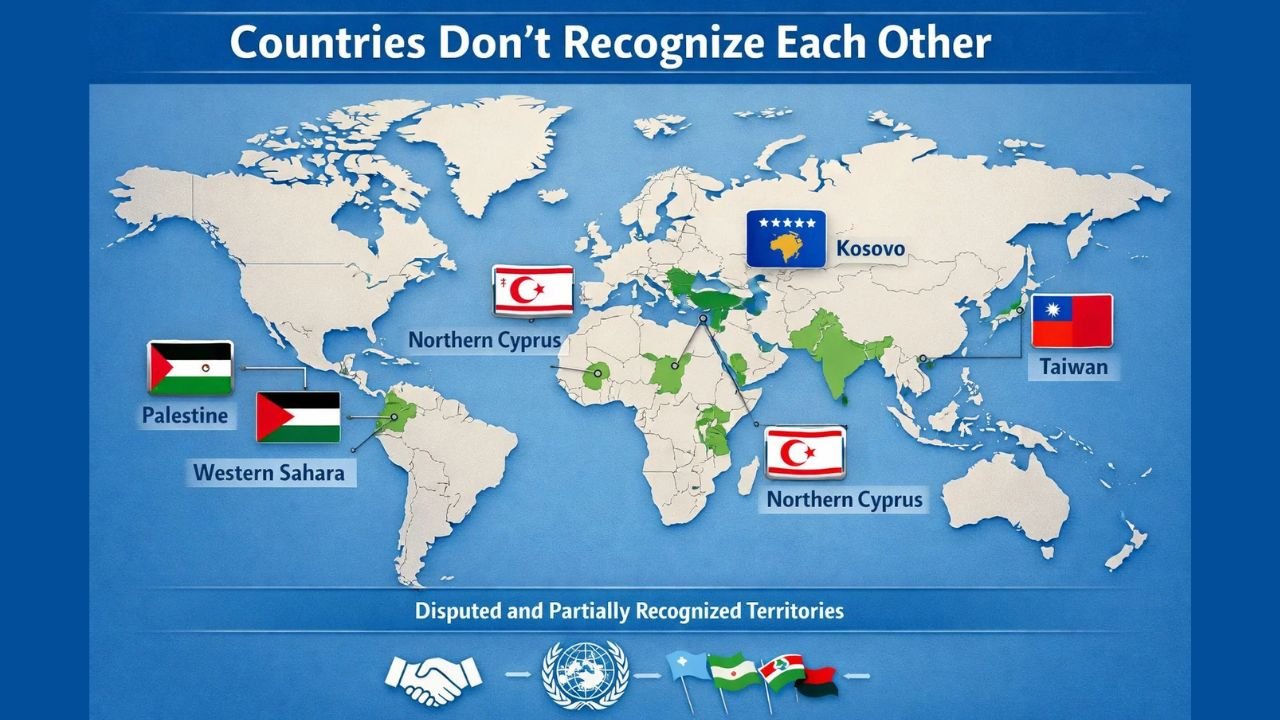
| Country / Territory | Who Doesn’t Recognize It | Reason |
|---|---|---|
| Taiwan | China + allies | One-China policy |
| Kosovo | Serbia, Russia, others | Territorial integrity |
| Palestine | Some Western states | Political dispute |
| Northern Cyprus | Most of world | International law |
| Western Sahara | Several countries | Territorial conflict |
Can a Country Exist Without Recognition?
Yes. A country can:
- Govern itself
- Control land
- Have armed forces
- Run elections
However, lack of recognition causes problems:
- Limited trade
- Travel restrictions
- No UN membership
- Economic isolation
Why Recognition Matters in Global Politics
Recognition impacts:
- Diplomacy
- Economic development
- Security
- International legitimacy
Without recognition, a country struggles to operate globally, creating situations where countries don’t recognize each other.
Does Recognition Ever Change?
Yes. Recognition is not permanent. Governments change, alliances shift, and global politics evolve. Many countries that were once unrecognized later gained acceptance.
The Role of the United Nations
The UN does not officially “create” countries, but:
- Membership boosts legitimacy
- UN votes influence recognition
- Security Council politics matter
Some states remain outside the UN despite functioning governments.
UN membership can strongly support recognition (United Nations).
Modern Challenges in Country Recognition
Today, recognition is influenced by:
- Cyber warfare
- Information campaigns
- Economic sanctions
- Global media
Recognition has become a strategic tool, and situations where countries don’t recognize each other are increasingly complex.
Conclusion
So, why do countries don’t recognize each other? The answer lies in politics, history, law, alliances, and fear of instability. Recognition is not about maps alone it is about power, interests, and global balance.
Understanding this helps us better grasp how international politics truly works beyond headlines.
FAQs
Q1: Is UN membership equal to recognition?
Not exactly, but it strongly supports recognition.
Q2: Can recognition be withdrawn?
Yes, though it is rare.
Q3: How many countries are partially recognized?
Several territories worldwide remain partially recognized.